

Benefits of Intentional Coffee Brewing: A Mindful Guide
Table of Contents
- What Intentional Coffee Brewing Actually Means
- The Benefits of Brewing Coffee Manually
- Mindful Coffee Brewing: Turning a Habit Into a Practice
- Building a Mindful Morning Routine Around Your Brew
- The Intentional Coffee Break: Reclaiming Ten Minutes of Your Day
- A Balanced Look at Coffee and Health Claims
- Matching Your Brew to Your Goals and Sensitivities
- Conclusion
- Frequently Asked Questions
Last Updated: October 17, 2026
What Intentional Coffee Brewing Actually Means
Intentional coffee brewing is the practice of preparing coffee with full attention to each step, from choosing the beans to pouring the water.
The difference is not the equipment. It is the attention.
Most people brew coffee on autopilot. Beans go in, water goes in, and the cup disappears while they scroll their phone.
That shift sounds small. It changes the whole experience of your morning.
The Benefits of Brewing Coffee Manually
Manual brewing gives you control that machines take away. You decide the water temperature, the grind size, the pour speed, and the timing.
A common mistake is assuming manual brewing is only for coffee snobs. It isn't. Anyone who can pour water in a circle can brew manually.
The real gains fall into a few buckets:
- Better taste. Freshly ground beans brewed with care taste noticeably different from a stale pod.
- A built-in pause. The process takes a few minutes. That time is yours.
- Sensory engagement. You smell, hear, and see the brew come together.
- Less waste. A paper filter and a cone beat a plastic pod for the planet.
That last point matters more than most guides admit. Sustainability and waste-conscious brewing are part of the appeal, not an afterthought.
How Brewing Variables Change the Cup
Four variables decide what ends up in your mug. Small changes swing the flavor a lot.
| Variable | What It Controls | Try This |
|---|---|---|
| Grind size | Extraction speed | Finer for slow pours, coarser for cold brew |
| Water temperature | How much flavor releases | Just off the boil for most methods |
| Brew time | Strength and body | Shorter for bright, longer for rich |
| Pour technique | Evenness of extraction | Slow spirals, steady rhythm |
Get one variable wrong and the cup turns bitter or sour. Get them aligned and the cup tastes balanced.
What most guides miss is that grind size is the lever you should adjust first. Change it before you touch anything else. A coarse grind in a pour-over will taste weak.
A Repeatable Pour-Over Method You Can Test
Here is a concrete starting point for a single cup using a cone dripper and paper filter. Treat the numbers as a baseline, then adjust one variable at a time.
- Weigh your beans. Start with 15 grams of coffee for 250 grams of water (about a 1:16 ratio). A kitchen scale is the single best upgrade for consistency.
- Heat your water. Aim for roughly 200°F (93°C). If you do not have a thermometer, boil the kettle and let it sit for about 30 seconds.
- Rinse the filter. Pour hot water through the paper filter to remove papery taste and preheat the cone. Discard the rinse water.
- Grind medium-fine. The texture should feel like table salt. Grind right before brewing.
- Bloom. Pour about 30 grams of water over the grounds and wait 30 to 45 seconds. Fresh coffee will bubble as gas escapes.
- Pour in stages. Add water in slow spirals, keeping the bed level. Finish the total 250 grams by about 2:30 to 3:00.
- Let it drain. The brew should finish dripping by around 3:30. If it drains much faster, grind finer; if it stalls, grind coarser.
Taste the result and adjust one thing next time. Sour or weak usually means under-extraction: grind finer or brew longer. Bitter or harsh usually means over-extraction: grind coarser or shorten the brew.

Water Quality and Equipment Longevity
Two overlooked variables are water and gear care. Coffee is mostly water, so hard tap water with heavy mineral content can mute flavor, while very soft water can taste flat.
Equipment longevity also matters for waste-conscious brewing. Rinse paper filters are compostable, but a reusable metal or cloth filter cuts waste further. Descale your kettle periodically, and let your grinder cool between uses.
Mindful Coffee Brewing: Turning a Habit Into a Practice
Mindful coffee brewing is the art of staying present through the whole process. It is the difference between drinking coffee and experiencing it. The practice borrows from mindfulness: you focus on one thing, and you let the rest wait.
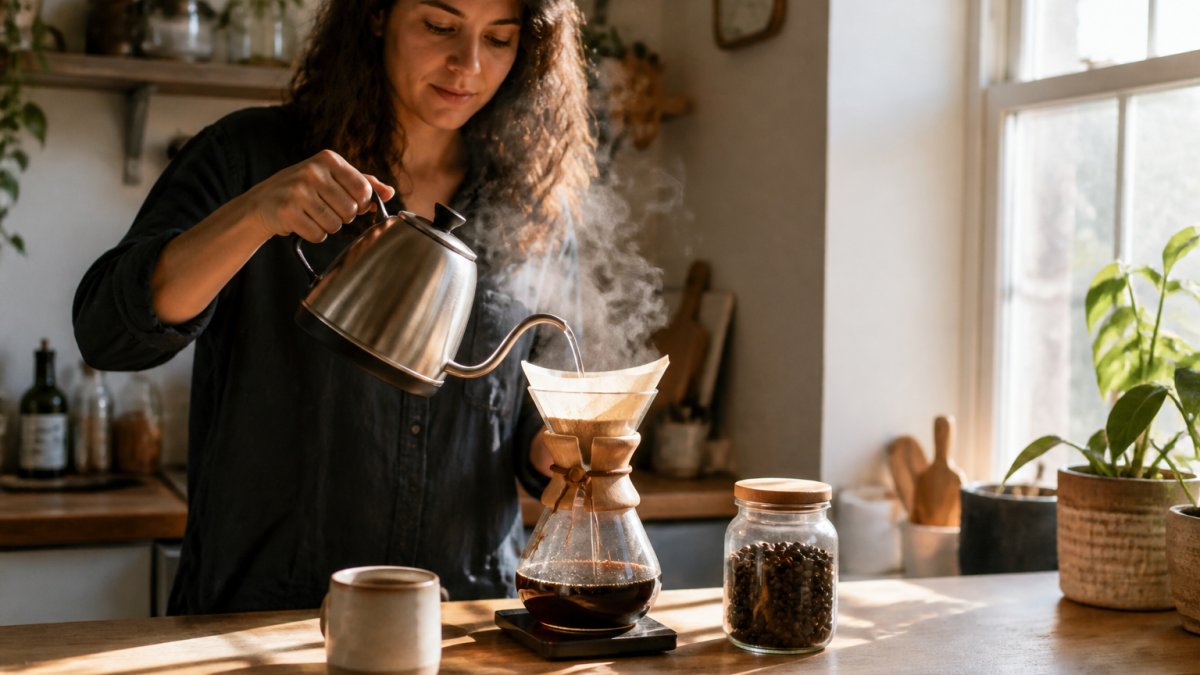
Here is how to make the shift from habit to practice:
- Set the stage. Clear your counter. Put your phone face down.
- Warm your mug. A warm cup keeps the coffee hot longer.
- Smell the grounds. Before water touches them, notice the aroma.
- Pour slowly. Watch the bloom as gas escapes.
- Sit with the cup. Take the first sip without doing anything else.
That is it. No incense required, though we won't stop you.
The point is presence. A coffee ritual works because it gives your mind one simple thing to hold onto before the day's noise starts.
Building a Mindful Morning Routine Around Your Brew
A mindful morning routine starts with the brew, not with your inbox. The order matters. If you check messages before your first sip, you hand your attention to someone else before you've had it yourself.
Build the routine in this order:
- Wake and drink a glass of water.
- Grind your beans while the kettle heats.
- Brew without a screen in front of you.
- Drink the first half of the cup slowly.
This sequence takes maybe fifteen minutes. It sets the tone for everything after.
If you want the routine to feel special, pick beans you actually look forward to. Our Bali Blue brings dark chocolate and molasses notes that make a slow morning feel like a treat. The Ethiopia Natural leans brighter, with milk chocolate and fruit.

The Intentional Coffee Break: Reclaiming Ten Minutes of Your Day
An intentional coffee break is a short, protected pause built around brewing and drinking one cup. It is a reset button in the middle of a workday. Remote workers need it most, because there is no office kitchen to walk to and no natural break in the day.
Here is how to take one that counts:
- Step away from your desk. Physically move.
- Brew by hand if you can. The process is the point.
- Leave the phone behind.
- Drink the whole cup before returning.
Ten minutes. That is the ask.
The payoff is a clearer head and a calmer mood when you sit back down. Many remote workers find that a real break beats a fake one spent scrolling.
A Balanced Look at Coffee and Health Claims
Coffee gets both hype and blame, and both go too far. Here is the honest version, sorted by how strong the evidence actually is.
What the Evidence Supports Reasonably Well
- Alertness and focus. Caffeine blocks adenosine, a molecule that builds up through the day and makes you feel sleepy. For most adults, a moderate dose improves attention and reaction time in the short term. This is one of the better-established effects.
- Antioxidants. Coffee contains chlorogenic acids and other polyphenols from the bean. These are real compounds, though how much they matter for long-term health is still being studied.
- Filtered coffee and cholesterol. Paper filters catch cafestol and kahweol, two oils in coffee that can raise LDL cholesterol. Unfiltered methods like French press and espresso leave more of those oils in the cup. If cholesterol is a concern, paper-filtered methods are the safer default.
What Is Preliminary or Mixed
- Long-term disease risk. Observational studies often link moderate coffee intake with favorable outcomes, but observational data cannot prove cause and effect. People who drink coffee differ from people who don't in many ways.
- Metabolism. Caffeine can slightly increase energy expenditure and fat oxidation in the short term, but the effect is small and tends to diminish with regular use. It is not a weight-loss strategy.
- Heart health. The picture depends on the person. Moderate intake is generally considered acceptable for most healthy adults, but sensitivity, existing conditions, and medication interactions matter.
What We Know About Individual Differences
Caffeine affects people differently based on genetics, tolerance, body weight, medications, and health status.
Pregnancy, heart conditions, anxiety disorders, and some medications are reasons to talk to a clinician before leaning on coffee. We are coffee people, not physicians.
The balanced take: coffee is not a medicine and not a villain. It is a drink with real effects, good and bad, that vary by person.
For a deeper look at caffeine and health, the World Health Organization's guidance on caffeine is a sensible starting point, and the FDA's consumer information on caffeine covers safe daily intake for most adults.
Matching Your Brew to Your Goals and Sensitivities
Your ideal brew depends on what you want from it and how your body reacts. There is no universal best cup.
Use this quick guide:
- Want focus for deep work? A medium roast brewed strong, early in the day.
- Want to wind down? A lighter cup, or switch to tea in the afternoon.
- Caffeine-sensitive? Try a smaller cup, a lighter roast, or a decaf option.
- Love the ritual more than the buzz? A slow pour-over is the whole point.
Our Single Origin Favorites Sample Pack is built for exactly this. Six small packs let you find the roast and region that fit your mornings, without committing to a full bag first.

Personalization is the whole game. Once you know how you respond to caffeine and what flavors you love, your brew gets better fast.
Conclusion
The hardest part of intentional coffee brewing is not the technique. It is protecting the time.
That is where we come in. Genevieve's Secret Grimoire Brew roasts fresh beans and builds each bag to turn your morning into a small ritual.
If you're ready to make your morning mean something, start with a bag of our freshly roasted coffee and brew it slowly. One cup.
Frequently Asked Questions
What does intentional coffee brewing mean?
Intentional coffee brewing means treating the process as a deliberate practice rather than an automatic step. You choose your beans, measure them, heat the water to a set temperature, and pay attention to the pour instead of rushing. The goal is not perfection but presence. A short pause to notice the aroma, the sound of the water, and the weight of the mug turns a two-minute task into a small ritual. Many people find that this attention makes the coffee taste better and the morning feel less rushed.
What are the benefits of brewing coffee manually?
Manual brewing gives you direct control over variables that shape the cup: grind size, water temperature, brew time, and the ratio of coffee to water. That control means you can adjust a sour or bitter result instead of accepting it. The process also slows you down, which supports focus and alertness before work. Many remote workers use a manual method as a natural transition into deep work. It requires only a dripper, a filter, a kettle, and a scale, so the equipment cost stays modest.
How can making coffee become a mindfulness practice?
Any repetitive routine can become a mindfulness practice when you bring attention to it. With coffee, that means noticing the smell of freshly ground beans, the sound of the kettle, and the rhythm of the pour. When your mind wanders to your inbox, you return to the next physical step. The sensory engagement is what makes it work: coffee aroma and taste give your attention something concrete to rest on. A few minutes of this before the day starts can support stress reduction and a calmer mood.
Is coffee healthy for you?
For most adults, moderate coffee consumption is considered compatible with good health, and some research links it to antioxidants and other potential benefits. The picture is not uniform: sleep quality, anxiety, and heart health can be affected in people who are sensitive to caffeine or drink it late in the day. Filtered coffee removes some of the coffee oils that raise cholesterol, which is one reason brewing method matters. If you have a cardiovascular condition or take medication, ask your doctor about your own limits rather than relying on general guidance.
The challenge is simple: your mornings are already happening. The question is whether you're brewing them on purpose. Genevieve's Secret Grimoire Brew makes that easy with freshly roasted single origins, a sample pack to find your favorite, and a subscription that keeps the ritual going. Get started with Genevieve's Secret Grimoire Brew and turn your daily cup into a small, magical spell for your day.